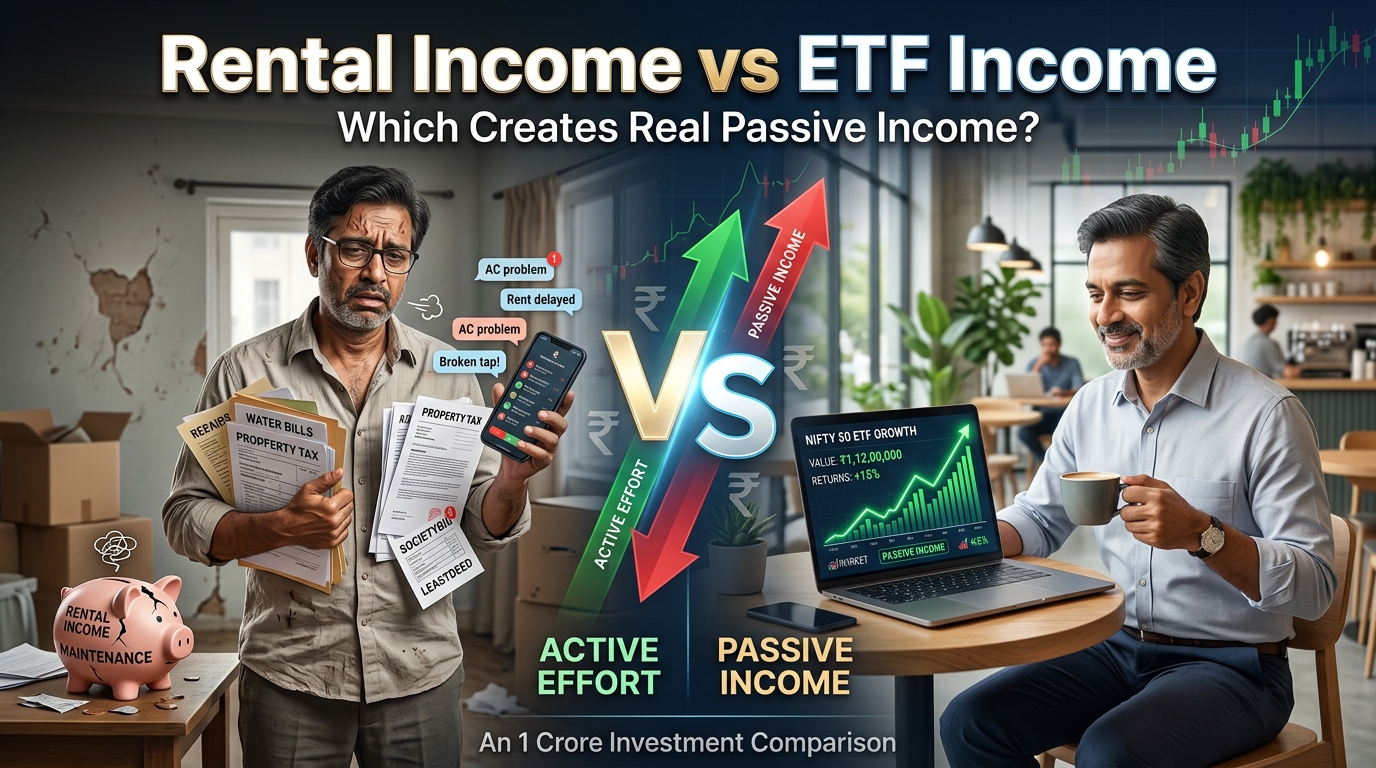
The dream is familiar. Buy a flat, rent it out, collect income, and tell yourself the asset is paying you every month. For decades, that has been one of the most emotionally attractive investment stories in India. It sounds stable, respectable, and practical. But many investors who actually become landlords discover something uncomfortable: rental income often behaves more like part-time work than true passive income.
The story behind this article is simple. A property may look like a dependable cash-flow machine when you first buy it. But over time, vacancies, society charges, property tax, maintenance, repainting, broker costs, tenant churn, and slow resale cycles start changing the experience. The monthly cheque may still come, but the journey can be far from passive.
That is why the real debate is not just rental income vs ETF returns. The better question is rental income vs ETF income: which creates real passive income? And for many modern investors, especially professionals and business owners who want cleaner financial systems, that question matters much more than it used to.
Quick takeaway: Rental property may give visible cash flow, but a Nifty 50 ETF often gives cleaner passive wealth creation because it is easier to hold, easier to scale, easier to exit, and far less operationally demanding.
Why Rental Income Feels More Comforting at First
Rental income has one huge advantage in the Indian mind: it feels real. You own a flat. You know where it is. You can visit it. You can see the tenant. There is psychological comfort in that physical ownership. Many families also believe a property is automatically safer than a market-linked investment because it does not flash red and green prices every second.
That comfort is understandable. But comfort and efficiency are not the same thing. The fact that an asset feels solid does not automatically mean it creates the best long-term outcome. In fact, what many investors call "stable" is sometimes just "illiquid and slow to reveal problems."
Passive income insight: If an asset demands regular attention, surprise expenses, negotiation, and follow-up, the income may be real, but the passivity is questionable.
What Makes ETF Income Different?
A Nifty 50 ETF does not give you rent. It gives you exposure to a basket of large Indian companies through one listed instrument. That means your money participates in market growth, and you can choose when and how to withdraw cash later. In other words, ETF income is often planned income, not automatic rent.
This distinction is important. Many investors assume passive income must mean monthly rent. That is too narrow. Real passive income can also mean building a portfolio that compounds with low friction and then drawing from it in a structured way. If the investment grows efficiently and lets you create controlled withdrawals later, that too is a passive-income engine.
One Crore Example: Rental Property vs Nifty 50 ETF for 20 Years
Let us take a simple illustrative example. Assume an investor has Rs 1 crore and wants passive income plus long-term wealth creation over the next twenty years. This is not a promise of return. It is a practical thinking framework.
Scenario A: Rs 1 crore in a rental property
- Capital locked in one property or one small cluster of units
- Gross rental yield may look reasonable on paper
- Net yield reduces after taxes, society dues, repairs, vacancy, brokerage, and upkeep
- Liquidity remains weak
- Scaling requires even more capital and effort
Scenario B: Rs 1 crore in a Nifty 50 ETF
- Capital remains liquid and market-linked
- No tenant management or property maintenance
- Returns may fluctuate, but administration is minimal
- Additional money can be added gradually over time
- Partial withdrawals are much easier than selling a flat
| Rs 1 Crore Comparison | Rental Property | Nifty 50 ETF |
|---|---|---|
| Income style | Monthly rent if occupied | Optional withdrawal plan from portfolio |
| Operational effort | Moderate to high | Low |
| Liquidity | Low | High |
| Diversification | Concentrated | Broad large-cap exposure |
| Scalability | Difficult | Easy |
| Surprise costs | Frequent possibility | Very low operational surprises |
| Exit friction | High | Low |
Twenty-Year Passive Income Thinking: What Really Changes?
Over twenty years, the biggest difference is not just return. It is how the experience compounds. With property, the investor keeps dealing with periodic friction. With an ETF, the investor mainly deals with market volatility and discipline. One is operational stress. The other is behavioural discipline.
For many investors, behavioural discipline is easier to manage than property friction. If you can stay invested through market cycles, a Nifty 50 ETF can become a cleaner long-term compounding vehicle. If you need income later, you can plan systematic withdrawals instead of relying fully on tenants.
Real passive income is not just about money coming in. It is about how little ongoing effort, uncertainty, and emotional energy the asset demands from you.
| 20-Year Passive Income Lens | Rental Property | Nifty 50 ETF |
|---|---|---|
| Year-to-year predictability | Depends on occupancy and upkeep | Depends on market cycle, but simpler to track |
| Income interruption risk | Vacancy can stop income | No tenant risk; withdrawals remain flexible |
| Wealth growth participation | Location-specific | Large-cap India growth participation |
| Capital access during emergencies | Hard | Much easier |
| Ease of passing through life changes | Lower flexibility | Higher flexibility |
But Does ETF Income Feel Like Income?
This is where many investors get stuck. Rent feels like income because it arrives from outside. ETF wealth feels like growth because it sits inside a portfolio. But if a portfolio compounds well and you can draw from it gradually later, then it can absolutely function as an income asset.
The difference is that rental property forces a specific structure on you, while an ETF gives you flexibility. You can stay in growth mode for years. You can later shift part of the portfolio into an income-oriented withdrawal strategy. You can rebalance. You can add SIP-style contributions. That flexibility itself has major value.
Investors often compare gross rent with market returns and stop there. That is incomplete. A real comparison must look at net yield, vacancy gaps, maintenance, tax drag, concentration risk, time spent managing the property, and difficulty of exit.
In contrast, an ETF is not free from risk, but its cost structure and maintenance burden are easier to understand. You are not calling plumbers, chasing tenants, or worrying whether a repair bill will wipe out a few months of expected rental comfort.
This is why some investors who once believed property was the only safe route later realise that passive, scalable market exposure can fit their lifestyle much better.
When Rental Property May Still Make Sense
This article is not saying property is always wrong. Rental property may still suit investors who strongly prefer physical ownership, understand their local market deeply, and are comfortable with low liquidity. It may also work for those who have enough surplus capital to tolerate non-passive management issues without stress.
But if the investor is mainly chasing the idea of passive income, then honesty matters. A rental flat is usually not passive in the pure sense. It is a physical business-like asset with monthly cash flow.
When a Nifty 50 ETF May Be the Better Fit
A Nifty 50 ETF often becomes more attractive for salaried individuals, business owners, and long-term wealth builders who want:
- Low operational friction
- High liquidity
- Simple scaling through regular investing
- Broad exposure instead of one-location concentration
- A portfolio they can later convert into structured income
For such investors, the better question may not be "property or markets?" It may be "how much of my capital should stay concentrated in physical real estate, and how much should move toward cleaner market-based compounding?"
My view as your partner in this: if your goal is not just owning assets but creating a calmer and more scalable wealth system, ETF investing deserves serious attention. Many investors are not short of assets. They are short of clarity.
So Which One Creates Real Passive Income?
If we define passive income honestly as income or wealth creation that demands very little ongoing operational effort, then ETF income often comes closer to the ideal than rental income. Rental property can still create cash flow, but it is usually not passive in the clean sense that most investors imagine.
Over twenty years, one crore in property may still create value, especially if the location performs well. But one crore in a Nifty 50 ETF may offer something many modern investors value more: flexibility, liquidity, simplicity, and cleaner long-term compounding. That does not guarantee better returns every year. It simply means the path may feel more efficient and far less exhausting.
Want to review whether your money should stay in property, move to ETFs, or be split more intelligently?
If you are confused about passive income planning, ETF allocation, long-term wealth building, or how to balance property with market exposure, let us review your current setup properly. Sometimes the right answer is not choosing one side blindly. It is building a clearer allocation strategy that matches your goals and stress tolerance.
- ETF-focused investing guidance for long-term wealth creation
- Portfolio review for investors overconcentrated in one property or one asset class
- SIP and passive investing frameworks for disciplined accumulation
- Allocation planning across real estate, ETFs, mutual funds, and equities
Disclaimer: This article is for educational purposes only and is not investment advice. Market-linked products, including ETFs, are subject to market risk. Real estate returns, rent, liquidity, and maintenance outcomes vary by city, property, tax treatment, and timing.